
For some businesses, an outage is an inconvenience. For others, it means spoiled product, a lost shift, a failed compliance obligation or a genuine safety issue. Sites at the end of long rural feeders, in storm- or bushfire-exposed areas, or on ageing distribution infrastructure often live with poor reliability and no cost-effective way to fix it. The usual answer is a diesel generator that has to be fuelled, tested and serviced, and that earns nothing between outages.
A battery energy storage system offers a better option. In normal operation, it runs grid-following, synchronised to the network and working to price and demand signals. When the grid is disturbed or lost, it switches to grid-forming within milliseconds to seconds. The inverters set their own voltage and frequency, and your site keeps running as an island on stored energy. This is proven technology, and the same control approach already helps keep Australia's grid stable.
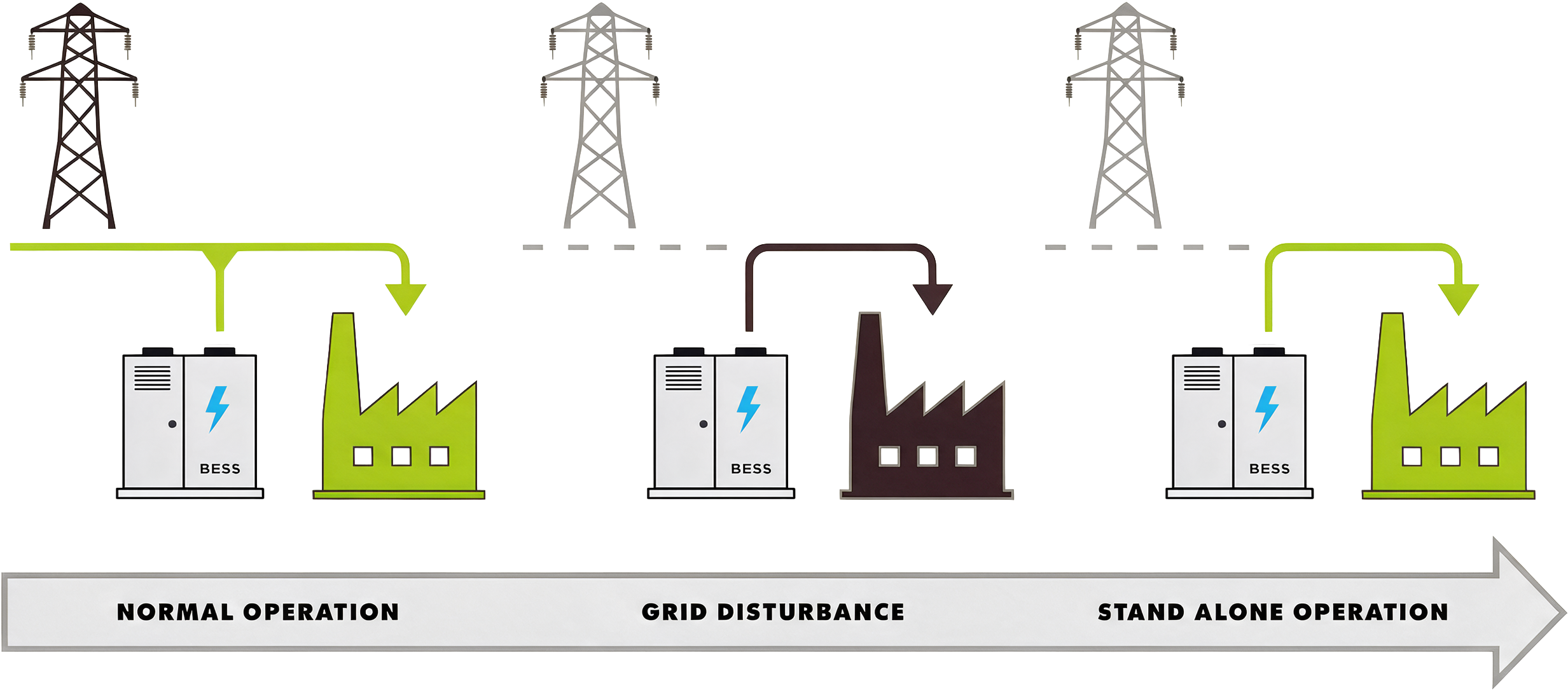
How long the system runs is a design decision. A two-hour system rides through most distribution outages. For longer autonomy, you can add battery expansion modules or run the BESS alongside existing generation such as microturbines, gensets or solar, with storage covering the instant transition and other plant covering extended duration. The benefits go well beyond backup:
- Transfer in milliseconds to seconds, with no meaningful gap for sensitive equipment to notice.
- No diesel set to fuel, test and service every month.
- Silent, emissions-free operation for urban and noise-sensitive sites.
- A daily return through arbitrage, demand reduction and solar storage, so resilience is not a stranded cost.
It suits aged care and health facilities, food processing and cold chain, manufacturing where an unplanned stop costs hours of restart, and sites on weak or rural feeders with a history of interruptions.
At Lynden Aged Care, a 375 kW, two-hour BESS with 300 kW DC of new solar works alongside an existing 99 kW AC array and microturbines. It stores power to reduce the risk of an outage while cutting grid consumption, allowing the facility to run off-grid for most of the year.