
According to McKinsey & Company, the global demand for sustainable fuels (including Green Liquid Fuels or GLFs) could quadruple by 2050 to up to 600 Mt/pa, driven by demand from hard-to-abate applications, notably road transport, marine, and aviation sectors. While the Australian market for renewable liquid fuels lacks some of the policy certainty and government stimulus programs of European and US markets, local demand from these sectors is increasing. These sectors are unlikely to be able to fully electrify as the energy system continues to decarbonise.
GLFs can include fuels such as biodiesel, Sustainable Aviation Fuel (SAF), Methanol, Dimethyl Ether (DME), and Green LPG.
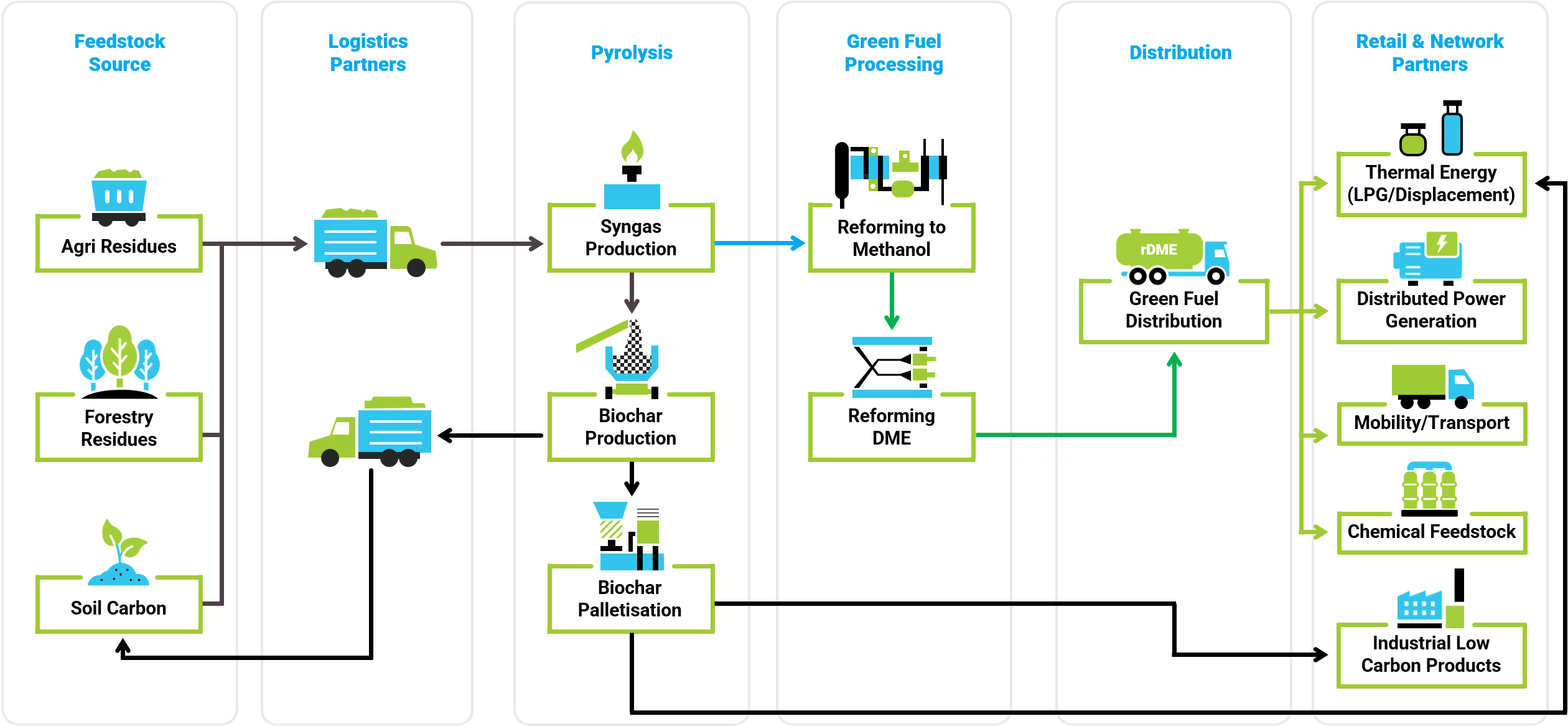
Green hydrogen, which has attracted significant industry and government attention, is a key feedstock to the production of many Green Liquid Fuels. The cost of hydrogen produced through electrolysis (a prominent method of green hydrogen production) is unlikely to reach the competitive cost of production needed to produce cost-effective GLFs without significant subsidies. However, in some applications, the cost of green hydrogen and other gases derived from biomass can produce a sufficiently low cost of feedstock to produce competitive renewable fuels.
For example, agricultural waste such as straw, manure, wood chips, paunch, crop trash, animal bedding, etc., along with tyre and forestry waste can be put into a pyrolysis reactor to produce syngas, which can replace natural gas in boilers and burners and can be upgraded to rDME to be used as a drop-in replacement for diesel, propane and other fossil-derived liquid fuels.
Optimal Green Fuels is planning to build five green fuel processing plants in Australia before 2032. Learn more about Optimal Green Fuels.