
Expansion plans often stall at the connection point. New production equipment, extra cold storage, electrified process heat or a bank of EV chargers can push your site's peak demand past what its existing supply allows. The answer from the network is usually an upgrade that is expensive, slow, or both, with approvals that can run well past a year and costs that often end up higher than first modelled.
A battery energy storage system changes the question. Instead of sizing your connection for the handful of intervals each year when demand peaks, you size it for the working average and let stored energy cover the difference. The BESS charges from the grid while demand sits comfortably under the limit, then discharges through the peak so grid import never crosses it. A site with a 300 kW connection, for example, could serve a 370 kW peak, with the top 70 kW coming from storage.
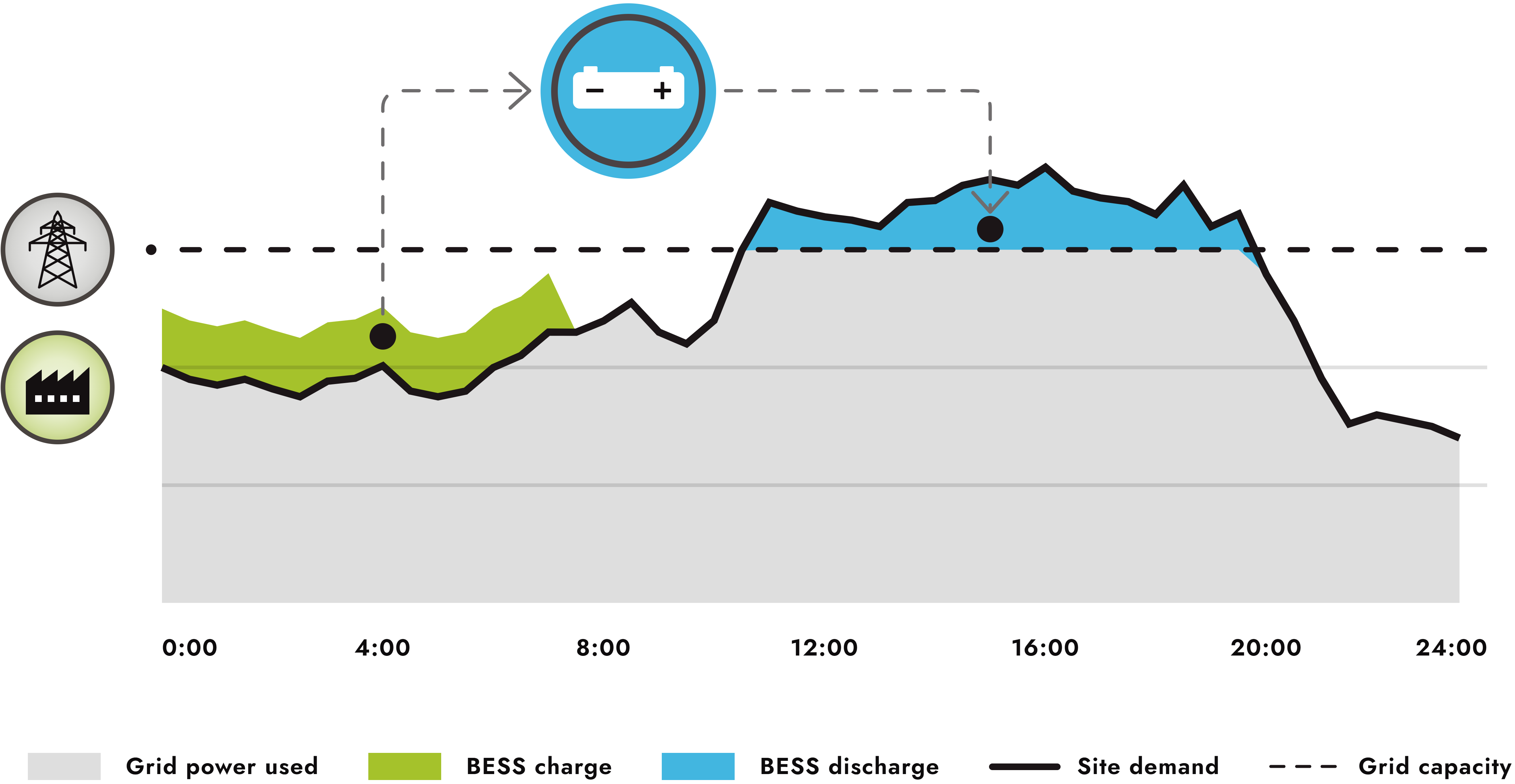
Because the same battery charges off-peak and discharges on-peak, it also cuts energy costs while it defers capital. The capacity case and the arbitrage case are not competing projects. They run on the same asset, and the benefits add up:
- Defers or avoids the cost of a network upgrade.
- Takes grid connection lead time off the critical path of your expansion.
- Keeps demand charges flat as the site grows.
- Modular and relocatable, so you can add capacity later or move it if the site changes.
It works best for sites adding new load, sites on constrained networks where an upgrade has been quoted as expensive or uncertain, leased premises, and staged developments that do not need full capacity on day one.
At Eaton Fair Shopping Centre in Bunbury, Western Australia, an 875 kW, four-hour BESS with an 800 kW DC solar car park stores energy off-peak for use in peak demand periods. It eases a grid constraint, reduces energy costs and supports the centre's next stage of growth.