
The National Electricity Market settles every five minutes, and prices can swing sharply across a single day. Midday solar regularly pushes wholesale prices very low, and at times below zero. A few hours later, the evening peak brings some of the day's most expensive intervals.
A battery energy storage system lets your site work that gap. It charges when energy is cheap or plentiful and discharges when it is expensive. Because it discharges when your site is drawing hardest, it also flattens the peak that sets your network demand charge. Network charges are often 40 to 50 per cent of a large commercial electricity bill, and a single highest interval in the billing period sets the demand component. Shaving that one interval can be worth more than most efficiency measures achieve in a year.
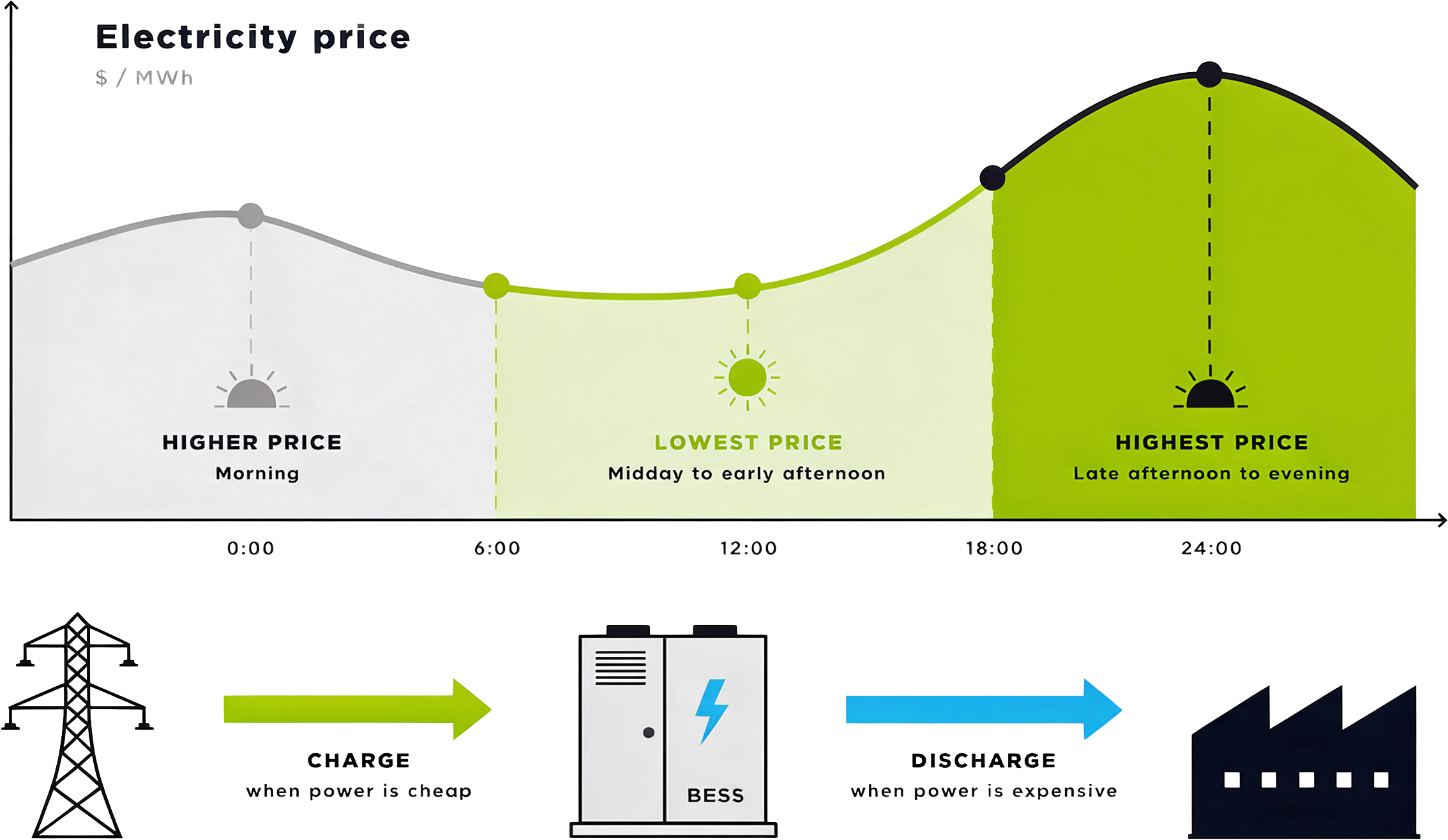
There are two ways to set it up:
- Behind the meter: the battery charges off-peak and discharges on-peak under your existing retail contract. The savings appear directly on your bill, and this simpler structure suits most sites.
- Front of meter: the battery sits behind a child meter and trades on the five-minute wholesale market in its own right, while your site stays protected under its retail contract. The battery takes the spot exposure, and your production does not.
We model both options during screening so you can see the difference before you choose. Arbitrage works best for sites on time-of-use or wholesale pass-through contracts, and for sites with sharp, repeatable demand peaks from refrigeration, compressors, HVAC or EV fleet charging.
Our Mulgrave head office runs a 125 kW, two-hour BESS with 99 kW DC of integrated solar PV and EV charging. It buys and sells energy on the wholesale spot market as part of a microgrid.