
Rooftop solar has done its job so well that the middle of the day is now the cheapest time for energy in the market, and the least valuable time to export. Many commercial sites find their surplus generation earning a very low feed-in rate, held back by an export limit, or even costing money to send out during negative price intervals. Meanwhile, the site's most expensive hours arrive in the evening, after the array has stopped producing.
A battery energy storage system closes that gap. Through the middle of the day, when generation exceeds site demand, the BESS absorbs the surplus instead of exporting it. Late in the afternoon, as solar output falls away and both demand and prices climb, the battery discharges into the site and keeps grid import down through the evening peak. The array does not change. What changes is when its output is worth something.
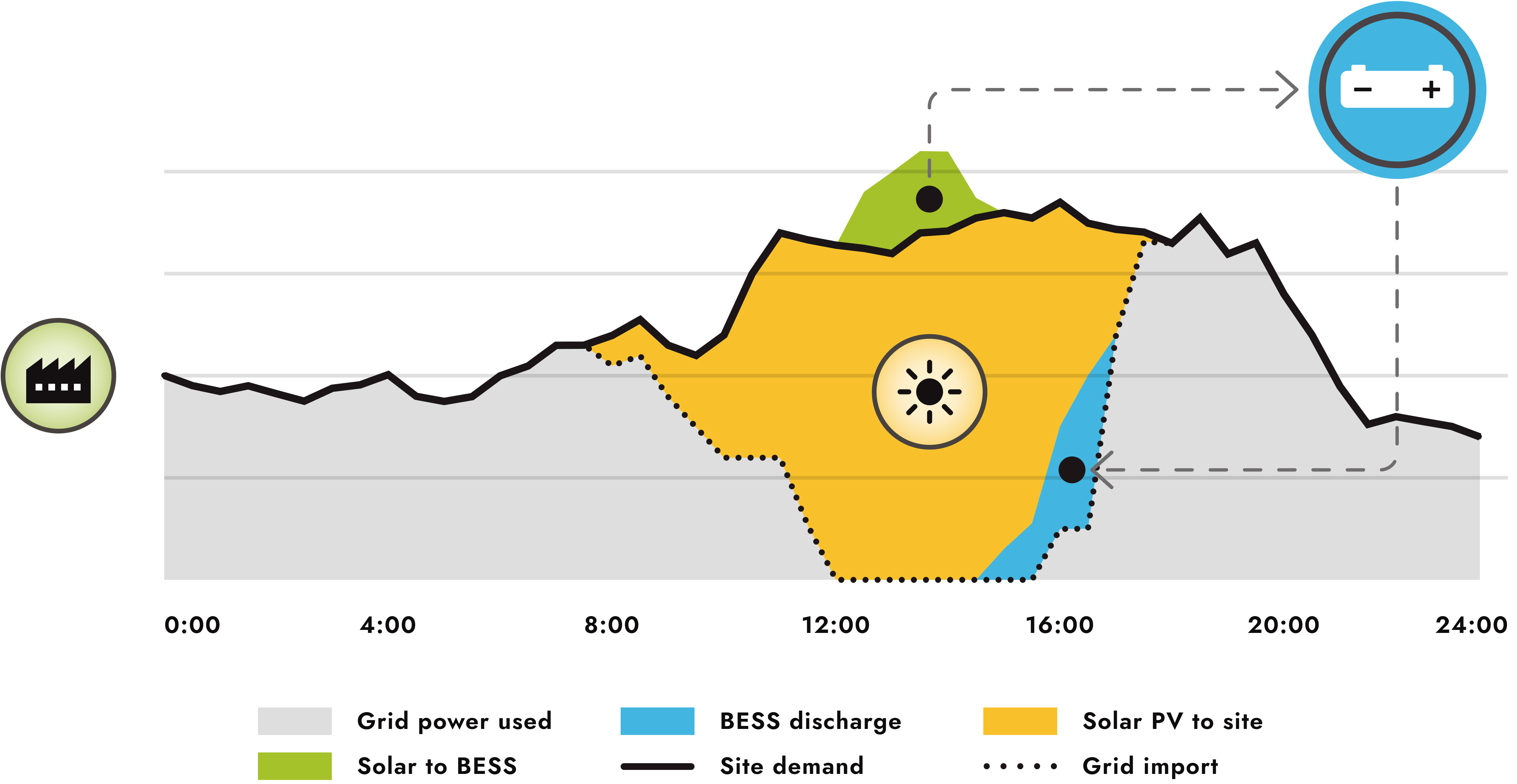
Storing solar rather than exporting it helps in several ways:
- Surplus generation displaces peak-rate import instead of earning a low feed-in rate.
- Generation that would be lost to export limits or curtailment is recovered.
- Covering the evening ramp from storage reduces demand charges.
- Higher self-consumption deepens emissions reductions.
- New or expanded solar becomes viable where the network will not accept more export.
For new installations, Optimal's All-in-One range includes a variant with direct DC solar input, so the array connects straight into the BESS rather than through a separate inverter chain. That means fewer conversion stages, less equipment on the wall and a single point of control for generation and storage.
It suits sites with existing solar exporting a meaningful surplus, sites facing an export limit, businesses with emissions targets, and sites that generate during the day but use most of their energy in the evening, such as hospitality, aged care and retail.