
Ask a business why it hasn't put in a battery yet, and the answer is rarely the technology. A well-sized Battery Energy Storage System (BESS) already earns its keep: it shaves network demand charges, shifts consumption away from expensive tariff periods, squeezes more value out of rooftop solar, and keeps critical processes running when the grid goes down. The catch has almost always been the upfront cost of getting a system in the ground.
From 1 September 2026, a new NSW Government incentive starts to change that. On that date, the NSW Government extends its Peak Demand Reduction Scheme (PDRS) to behind-the-meter business batteries for the first time.
What is the PDRS scheme?
The Peak Demand Reduction Scheme started operating in 2022 and is legislated to run through to 2050. Its purpose is straightforward: reduce peak electricity demand, particularly on hot summer afternoons and evenings when the NSW grid is under the most strain, by paying financial incentives to households and businesses that install or activate equipment which shifts, reduces or responds to that peak.
 Purpose of the scheme is to reduce peak electricity demand, particularly on hot summer afternoons and evenings when the grid is under the most strain.
The reason for the scheme comes down to how the grid is built. The network must be big enough to handle the single highest moment of demand all year, even though that peak might last only a few hours. Building for those brief spikes means more poles, wires and peaking generation, and that cost ends up on everyone's bills. By paying consumers to take load off the system during the peak window, the scheme reduces the need for that infrastructure, helps keep the grid reliable, and supports the state's targets of a 70 per cent cut in emissions by 2035 and net zero by 2050.
Commercial and industrial sites are central to this, because businesses use electricity very differently to homes. Many run heavy loads through the day, pay large demand charges based on their highest peaks, and run equipment that causes sharp spikes in consumption. Others are exposed to wholesale prices or have already invested heavily in rooftop solar. The benefits of storage for these sites are real, but the upfront investment has kept many otherwise sound projects on the shelf.
How does it work?
The most important thing to understand is that the PDRS is not a government cheque. It is a market-based scheme.
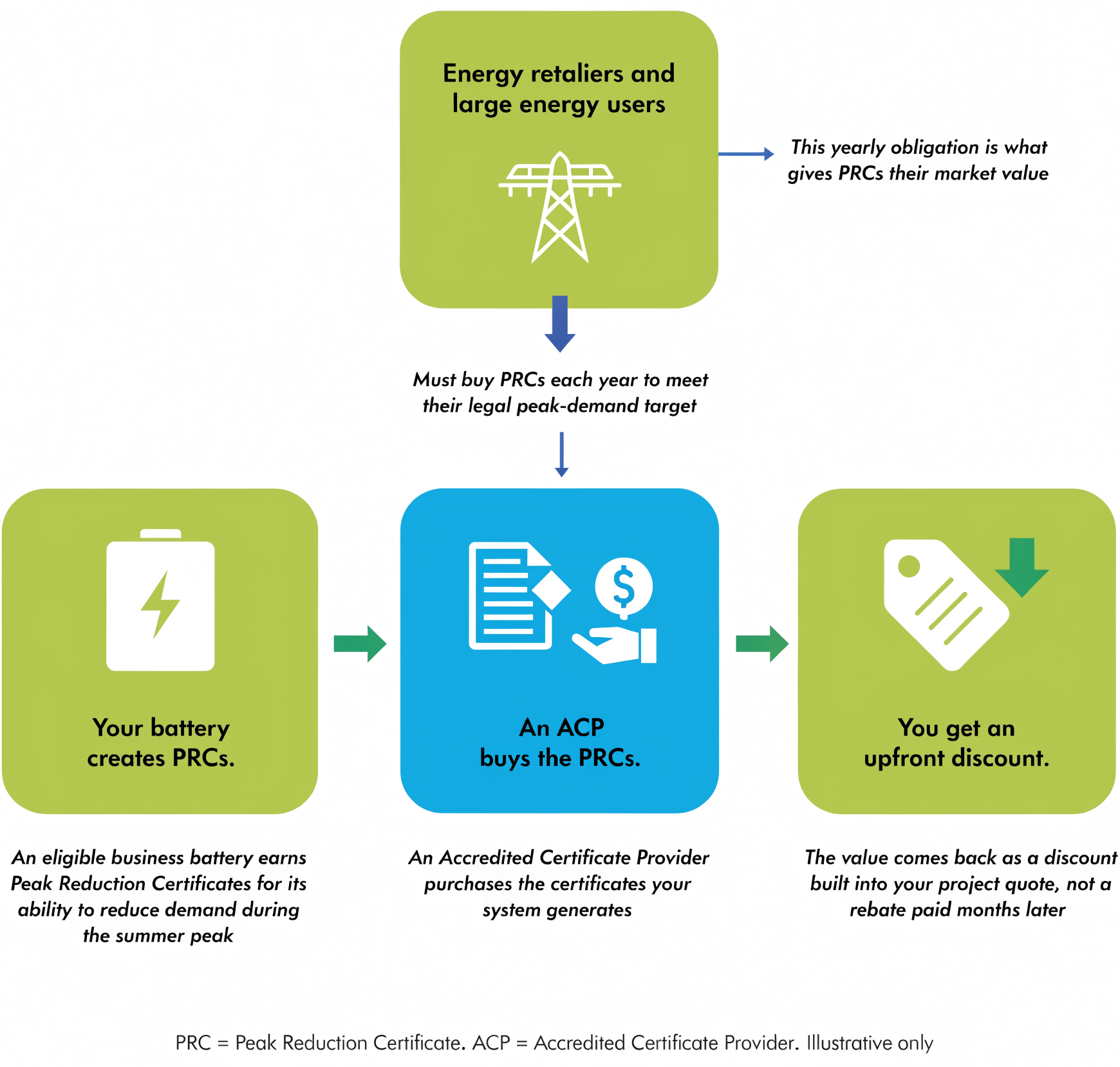
In the words of the NSW Government, “the scheme sets a peak demand reduction target for electricity retailers and large electricity users. To meet their targets based on their contribution to peak demand, energy retailers and large energy users are required to create or buy Peak Reduction Certificates (PRCs)”.
Eligible projects, including battery installations, create those certificates. An Accredited Certificate Provider (ACP) buys the certificates your system generates and passes the value back as an upfront discount on the project cost. In other words, the incentive is built into the price you are quoted, rather than paid back to you months later.
The tiers suitable for businesses
Three new battery activities arrive together, but two of them are aimed squarely at business: BESS4 and BESS5. A site can claim only one of them, once.
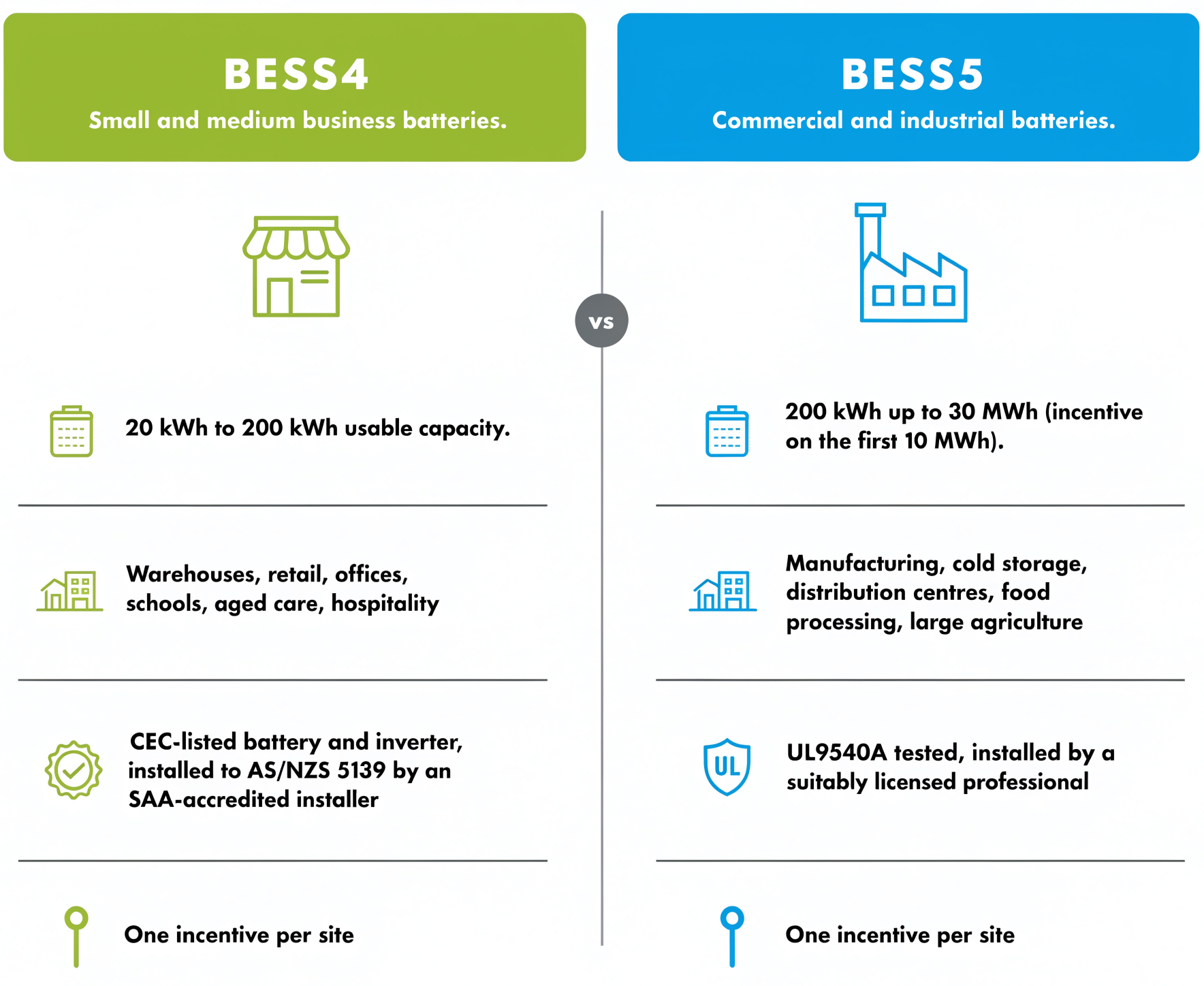
BESS4: small and medium business batteries
BESS4 covers batteries at small and medium business premises, excluding residential buildings and data centres. In brief:
- Capacity band: Combined usable capacity between 20 kWh and 200 kWh.
- Equipment and install: Battery and inverter must sit on the Clean Energy Council's approved lists, with installation to AS/NZS 5139 by an SAA-accredited installer.
- Typical sites: Warehouses, logistics facilities, retail centres, offices, schools, universities, aged care and healthcare facilities, sporting precincts, community facilities, hospitality venues, etc.
BESS5: commercial and industrial batteries
BESS5 is the activity built for scale, and it is where most of our customers sit. The key parameters:
- Capacity band: Combined usable capacity from 200 kWh up to 30,000 kWh (30 MWh), although the incentive itself applies only to the first 10,000 kWh (10 MWh).
- Equipment and install: Batteries must be tested to UL9540A, the standard that addresses thermal runaway propagation, and installed by a suitably licensed professional.
- Typical sites: Manufacturing plants, shopping centres, cold storage facilities, distribution centres, large warehouses, food processing sites, industrial estates, large agricultural operations, commercial property portfolios, etc.
Quantifying the payback impact
The exact payback for any given site will move with certificate prices, tariff structure, load profile and system design, which is why we model each project on its own numbers rather than quoting an average.
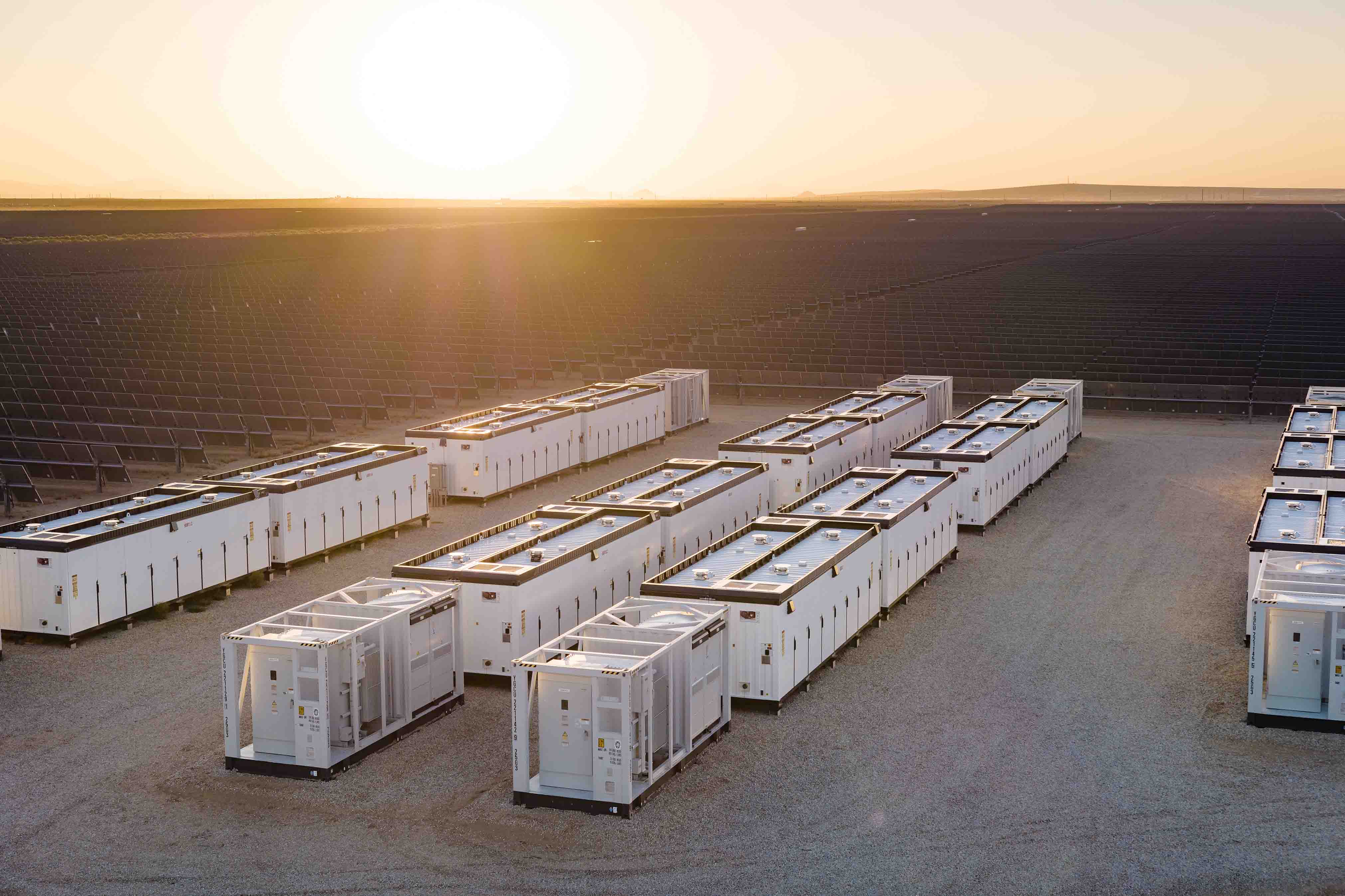 The exact payback for any given site will move with certificate prices, tariff structure, load profile and system design.
Two points are worth going in with eyes open on:
- The PRC price is not fixed. Certificates have historically traded between roughly $0.90 and $3.60, with a tax-effective penalty rate of around $3.45 acting as an effective ceiling. The market is still relatively young and subject to regulatory intervention, so the dollar value is not locked until the ACP has priced or hedged it.
- Installation quality is the real differentiator. Incentives attract operators of varying quality, and for large batteries the safety and engineering stakes are high. Demonstrable engineering competence, correct sizing and genuine warranty support matter more than the headline price.
How Optimal Group can help
For a business weighing up the PDRS scheme, the practical path runs from feasibility through to a supported, operating asset:
- Assess: Review the site's load and tariff profile to confirm it is a good fit and to size the system correctly, since inverter sizing and any paired solar directly shape both the site savings and the certificate value.
- Confirm eligibility: Check the design against the BESS4 and BESS5 requirements, including approved product, controllability and safety obligations.
- Procure and install: Source Tier 1 equipment and install using suitably licensed professionals, then commission the system.
- Apply the incentive: Working with an ACP, the value is delivered as an upfront discount, reducing the project's capital cost from the outset and improving debt serviceability, PPA economics and internal rate of return.
- Operate and support: Maintain and service the asset over its life under one accountable contract.
Using a specialist EPC means one company stays accountable for every step, including the decisions that most affect your return.
Optimal Group has delivered tailored energy solutions since 2012 across Australia, New Zealand and the Pacific, including microgrids, stand-alone power systems and, more recently, standalone BESS.
 A twin-microgrid demonstrator at our Mulgrave head office, built with Delta Electronics, combining battery storage and EV charging.
For larger commercial and industrial systems, we are deliberately technology agnostic, integrating proven power conversion systems from suppliers such as Delta and Hitachi Energy with battery technologies from established manufacturers including BYD and Sunwoda, in either AC or DC coupled architectures, for both new build and retrofit sites.
If commercial or industrial storage is on your agenda, talk to our team about how the PDRS scheme could reshape the economics of your project.
Sources
Amperage. (2026, July 8). NSW battery rebate 2026: BESS1–BESS5 PDRS explained. Amperage. https://amperage.app/blog/nsw-battery-rebate-2026-bess-pdrs-explained
Energy Savings Scheme & Peak Demand Reduction Scheme. (n.d.). Peak Demand Reduction Scheme (PDRS). IPART. https://www.energysustainabilityschemes.nsw.gov.au/peak-demand-reduction-scheme-pdrs
National Carbon Bank of Australia. (n.d.). BESS3, BESS4 & BESS5: New PDRS battery activities NSW. https://www.nationalcarbonbank.com.au/commercial-battery-installer-nsw-bess3-bess4-bess5
NSW Climate and Energy Action. (2026, August 14). Peak Demand Reduction Scheme. NSW Government. https://www.energy.nsw.gov.au/nsw-plans-and-progress/regulation-and-policy/energy-security-safeguard/peak-demand-reduction-scheme
Hamilton, L. (2026, May 21). NSW PDRS business battery incentive: What every business needs to know. Smart Commercial Energy. https://www.smartcommercialenergy.com.au/resources/nsw-business-battery-rebate-pdrs-what-every-business-needs-to-know
Felix. (2026, July 22). NSW commercial battery rebate 2026: BESS4 & BESS5. Solbase. https://solbase.com.au/nsw-commercial-battery-rebate-bess4-bess5/
Vorrath, S. (2025, November 3). "Shockwaves through the market:" NSW slashes peak demand reduction target amid home battery rebate fallout. Renew Economy. https://reneweconomy.com.au/shockwaves-through-the-market-nsw-slashes-peak-demand-reduction-target-amid-home-battery-rebate-fallout/
Vorrath, S. (2026, July 3). Solar battery rebate expanded to apartments and big energy users for up to 30 MWh in game-changing move. Renew Economy. https://reneweconomy.com.au/solar-battery-rebate-expanded-to-apartments-and-big-energy-users-for-up-to-30-mwh-in-game-changing-move/